

Standing at a jeweller’s counter with two rings that look identical, most buyers assume the prices will match. They rarely do. One stone can cost hundreds of pounds more than its neighbour while appearing the same to the naked eye, and the reason sits in four measurable qualities that shape every diamond ring on the market. These are the 4Cs, cut, colour, clarity and carat weight. In Hatton Garden, London’s historic jewellery quarter in the EC1N postcode of Holborn, understanding these four factors separates paying a fair price from overpaying for a grade you cannot see. This article explains what each of the 4Cs does to the cost of a diamond ring London buyers actually consider, how the grades interact, and how to sense-check a figure before you commit. Whether you are choosing a first engagement ring Hatton Garden shoppers dream about or comparing bespoke options a short walk from Chancery Lane, the same principles apply, and they put you in control of the conversation rather than at its mercy. If you are starting the search from scratch, our advice on choosing an engagement ring in Hatton Garden covers the wider decision.
What the 4Cs Actually Mean for a Diamond Value
The 4Cs are the four standardised measures that determine a diamond’s quality and price, namely cut, colour, clarity and carat weight. Developed by the Gemological Institute of America, they give buyers and jewellers a shared language, so a stone graded in London means the same thing anywhere in the world.
Cut describes how well a diamond’s facets return light, not the shape of the stone. Colour measures how close a diamond sits to colourless, running from D at the top of the scale down to Z. Clarity records the tiny natural inclusions formed inside the stone, from Flawless through to Included. Carat is weight alone, where 1 carat equals 0.2 grams. A GIA certified diamond carries an independent report on all four, which is why certification matters so much once you move past modest budgets.
Two of the most respected laboratories, the GIA and the IGI, grade to slightly different tolerances, and HRD Antwerp is a further recognised name in Europe. A like-for-like comparison should always check which body issued the report, because a colour or clarity grade from one laboratory does not always match the same grade from another, a distinction explained in our overview of how diamond certification works.
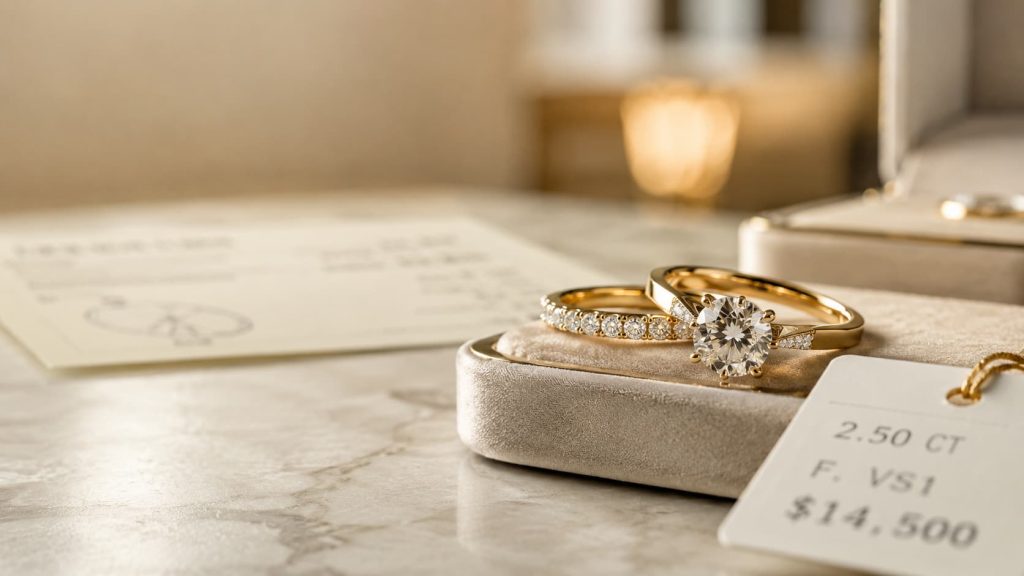
How Cut Quality Changes a Diamond Price More Than Buyers Expect
Cut has the strongest effect on how beautiful a diamond looks and a serious effect on what it costs. A well cut stone returns light as brightness, fire and scintillation, while a poorly cut one can look lifeless even at a generous carat weight. Cut grade, rather than size, is where much of the value quietly sits.
The factors behind a cut grade include crown angle, pavilion depth and girdle thickness, the proportions that decide how light travels through the stone and back to your eye. A brilliant cut diamond with excellent proportions will often outshine a larger stone cut to weaker angles, and it can command a higher price per carat as a result. This is why an experienced Hatton Garden jeweller steers a careful buyer towards cut before carat.
Shape and cut are not the same thing. A princess cut, an emerald cut and a round brilliant each follow different proportion targets, so comparing cut quality only makes sense within the same shape. Buyers who fix on carat weight first often pay for size they can barely see, then wonder why a smaller ring across the counter holds more life.
What Colour and Clarity Add to the Final Price
Colour and clarity fine-tune a diamond’s price once cut and carat are settled. Colour grades run from D, meaning completely colourless, down through the near-colourless range of G to J, where faint warmth appears only under close inspection. Clarity grades record internal inclusions from Flawless to Included.
The value lesson in colour is that the eye struggles to tell D from G once a stone is set in a ring. Many informed buyers choose a near-colourless grade such as G or H and put the saving towards a better cut. Fluorescence grading adds another layer, since strong fluorescence can slightly lower a stone’s price while rarely affecting its everyday appearance.
Clarity follows a similar logic. An eye-clean stone graded VS1, VS2 or SI1 shows no inclusions to the naked eye, yet costs considerably less than a Flawless equivalent. Paying a premium for perfection you cannot see is the most common way buyers overspend. A trustworthy jeweller shows you the inclusions under a loupe so you understand exactly what you are, and are not, paying for.
How to Estimate a Diamond Price Before You Visit a Jeweller
The most practical way to judge a fair price is to model the 4Cs yourself before you walk into a shop, because the four grades move independently and interact in ways that are hard to hold in your head. A diamond price reference calculator lets you adjust shape, carat, cut, colour and clarity and watch the estimate respond, which turns an abstract set of grades into a figure you can reason about.
Treat any calculator result as a reference point rather than a firm quote. Real prices vary with market conditions, certification, setting complexity and the individual character of a stone. What the exercise gives you is confidence, so that when a jeweller quotes a number you already understand the range it should fall within and can ask sharper questions about why a particular stone sits where it does.
Arriving informed also changes the tone of the appointment. Instead of accepting grades on trust, you can compare the certificate in front of you against the combinations you modelled at home. That habit alone protects buyers from paying over the odds for a bespoke diamond ring London workshops can otherwise present without much scrutiny.
Where the 4Cs Fit Into Choosing a Ring in Hatton Garden
Hatton Garden concentrates more diamond expertise in a few streets than anywhere else in Britain, which makes it the natural place to put the 4Cs into practice. The quarter sits in the London Borough of Camden, moments from Chancery Lane station and a short walk from the Farringdon Elizabeth line exit, so comparing several jewellers in an afternoon is genuinely realistic.
One recent shift is worth holding in mind. Lab-grown diamonds are chemically identical to mined stones yet sell at a markedly lower price, and as of 2025 their cost has fallen sharply. Any buyer weighing options should confirm whether a stone is natural or laboratory grown before reading its 4Cs, because the same grades carry very different prices across the two, and a calculator estimate assumes one or the other.
Timing matters more than most buyers expect. Appointments fill quickly in the weeks before Christmas and Valentine’s Day, the two busiest proposal seasons, so booking ahead protects both choice and attention. When you visit, ask to see the certificate for any stone above a modest weight, confirm the metal carries a London Assay Office hallmark, and check what aftercare, resizing and insurance valuation the jeweller provides.
Buyer protection sits behind the sparkle too. The Consumer Rights Act 2015 covers goods that turn out to be faulty, and independent certification protects you on the quality of a high value stone. Membership of the National Association of Jewellers or the Responsible Jewellery Council is a further reassurance worth asking about, since both signal standards a casual retailer may not meet.
Fun fact: The word carat traces back to the carob seed, once used as a counterweight on jewellers’ scales because the seeds were unusually consistent in mass.
Anyone about to choose a diamond ring should treat the 4Cs as their strongest negotiating tool, not as jargon to nod along to. Book an appointment with a Hatton Garden jeweller who will show you stones under a loupe, model a few grade combinations in advance so you know your range, and lead with cut rather than carat when you weigh up options. Ask which laboratory graded the stone, confirm the hallmark, and check resizing and insurance valuation before you pay. Allow extra time in the busy months before Christmas and Valentine’s Day. Understand these four factors and you will buy a better ring for the same money, or the same ring for less, which is the whole point of learning them.