

Clearing out a relative’s belongings and finding a box of old rings, most people have no idea whether they are holding modest costume pieces or several thousand pounds of diamonds and gold. Inherited jewellery sits in a strange gap, part sentiment, part unknown asset, and the uncertainty is exactly what leaves owners exposed to a poor offer. In Hatton Garden, London’s diamond quarter in the EC1N district of Holborn, jewellers value inherited pieces every day, and the process is far less mysterious than it feels from the outside. This article explains how a jewellery valuation Hatton Garden owners can trust actually works, why the diamonds in old rings so often surprise their owners, what hallmarks reveal about a piece, and how to arrive with your own rough estimate before you sell, insure or remodel. Whether you plan to keep an heirloom, redesign it into something wearable, or release its value, understanding what drives the figure protects you from the two classic mistakes, selling too cheaply and insuring for the wrong amount. If you would rather keep a piece than part with it, our overview of redesigning an old ring into a modern setting sets out what is possible.
How Jewellers Work Out What Old Jewellery Is Worth
A jeweller values old jewellery by assessing four things, namely the stones, the metal, the craftsmanship and the market for that style. Each piece is examined for diamond and gemstone quality, its precious metal content confirmed by the hallmark, and any signs that the design or maker carries collectable value beyond raw materials.
The single biggest variable is usually the main stone. A central diamond is graded on the same 4Cs, cut, colour, clarity and carat, that apply to a new engagement ring, though older stones follow older cutting styles. The metal is weighed and multiplied by its purity, so an 18ct gold band holds more intrinsic value than a 9ct one of the same weight, and platinum more again.
Two figures then emerge, and they are rarely the same. There is the intrinsic or scrap value of the raw gold and stones, and the retail or replacement value of the piece as a finished object. Insurance valuations use the higher replacement figure, while a quick sale sits closer to intrinsic value, which is why an owner selling and an owner insuring can receive very different numbers for one ring, as our note on insurance valuations explained makes clear.
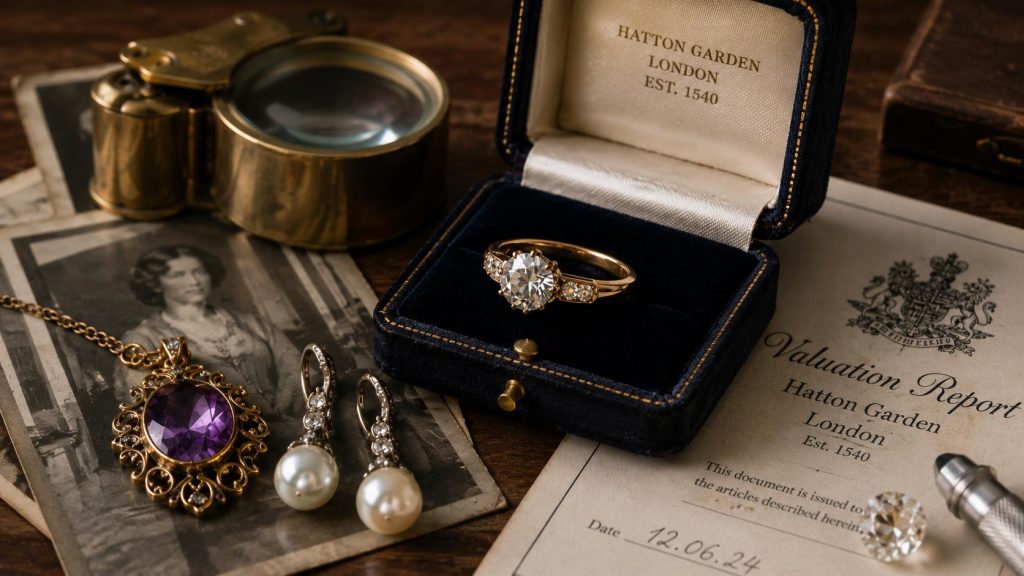
Why the Diamonds in Old Rings Often Surprise Their Owners
Diamonds in inherited rings frequently carry more value than owners expect, because older stones were cut by hand to designs that are now scarce. An old European cut or old mine cut diamond has a character that modern machine cutting cannot reproduce, and for the right buyer that history adds a premium rather than a discount.
These antique cuts follow different proportions from today’s round brilliant, with smaller tables, higher crowns and larger facets that give a soft, candlelit sparkle. A jeweller who understands them will not simply grade them against modern standards and mark them down. The diamond ring London market includes collectors and designers who actively seek antique stones for bespoke commissions.
The reverse also happens. A large stone in a grand old setting can disappoint once it is unmounted and graded, revealing heavy inclusions or noticeable colour that the mount concealed. This is why any serious valuation examines a stone out of its setting, under a loupe, rather than trusting the impression a ring gives on the hand.
Coloured gemstones deserve the same caution. Old rings often hold sapphires, rubies or emeralds whose value turns on origin, treatment and clarity in ways a quick glance cannot reveal. Demand for antique and vintage styles has grown in recent years, and as of 2025 a well-preserved period piece can attract genuine collector interest rather than a simple scrap offer.
What Hallmarks and Metal Content Tell You About Value
A hallmark is the official stamp that confirms a precious metal’s purity, and on British jewellery it is the fastest route to understanding part of a piece’s value. Struck by an Assay Office, the marks record the metal, its fineness, the sponsor who submitted it and often a letter dating the year of testing.
Reading a hallmark tells you whether a band is 9ct, 18ct or 22ct gold, sterling silver, or platinum, each of which carries a different intrinsic worth. The London Assay Office and the Birmingham Assay Office are the names most often seen on English pieces. A date letter can also reveal that a piece is genuinely antique, which may lift its value above the metal alone.
Not every old piece is hallmarked, since very small items and some imported or pre-regulation jewellery escaped the requirement. Absence of a mark does not make a piece worthless, but it does mean the metal must be tested directly. A reputable jeweller explains which marks your pieces carry and what they mean before discussing any figure.
How to Get a Sense of Value Before You Sell or Remodel
The strongest position an owner can take is to arrive with a rough estimate already in mind rather than a blank slate, because a first offer is far easier to judge when you have a reference point. Where a piece is built around a diamond, modelling its likely grades in advance gives you a sensible range to work from. A diamond price reference calculator lets you enter approximate shape, carat, colour and clarity and see an indicative value respond.
Any estimate you reach this way is a starting point, not a verdict. Antique cuts, unusual settings and collectable makers all sit outside a simple grade-based figure, and only an in-person assessment can account for them. What the exercise buys you is the confidence to ask why an offer sits where it does, and to walk away calmly if the answer does not add up.
This preparation matters most when the plan is to remodel rather than sell. Knowing the rough worth of the stones in an heirloom helps you decide how much to invest in a new setting, and lets you brief a bespoke jeweller with realistic expectations about what your existing diamonds can become.
Selling Insuring or Redesigning an Heirloom in Hatton Garden
Hatton Garden is the natural place in Britain to value, sell or reimagine inherited jewellery, with dozens of specialists and workshops within a few streets. The quarter sits in the London Borough of Camden, a two-minute walk from Chancery Lane station and close to the Farringdon Elizabeth line exit, so gathering more than one opinion in a single visit is straightforward.
For a redesign, a bespoke jeweller can lift diamonds from a dated mount and reset them into a contemporary ring, keeping the sentiment while making the piece wearable again. Bespoke commissions of this kind commonly take several weeks, so allow time if the result is meant for an anniversary or proposal. Ask to see the workshop’s approach, whether stones are set in-house, and what aftercare follows.
Whatever the route, protect yourself before money or metal changes hands. Obtain a written valuation for insurance, keep any grading certificate, and remember that the Consumer Rights Act 2015 applies to any new work carried out. Membership of the National Association of Jewellers is a reasonable reassurance to look for. If you sell, get more than one offer, since figures for the same piece can vary widely across a single street.
Fun fact: Diamonds cut before the 1920s were shaped almost entirely by hand and eye, so no two old European cut stones catch the light in quite the same way.
Anyone holding inherited jewellery should resist the urge to accept a first offer or tuck the pieces back in a drawer unexamined. Take them to a Hatton Garden jeweller who will assess the stones out of their settings, read the hallmarks aloud, and explain the difference between scrap and replacement value. Model the likely worth of any central diamond in advance so you know your range, photograph each piece alongside any paperwork you hold, obtain a written valuation for insurance, and gather more than one opinion before selling. If sentiment points towards keeping a piece, a bespoke redesign can turn an unworn heirloom into something loved again. Understand what drives the figure and you protect both the money and the memory, which is what inherited jewellery deserves.